

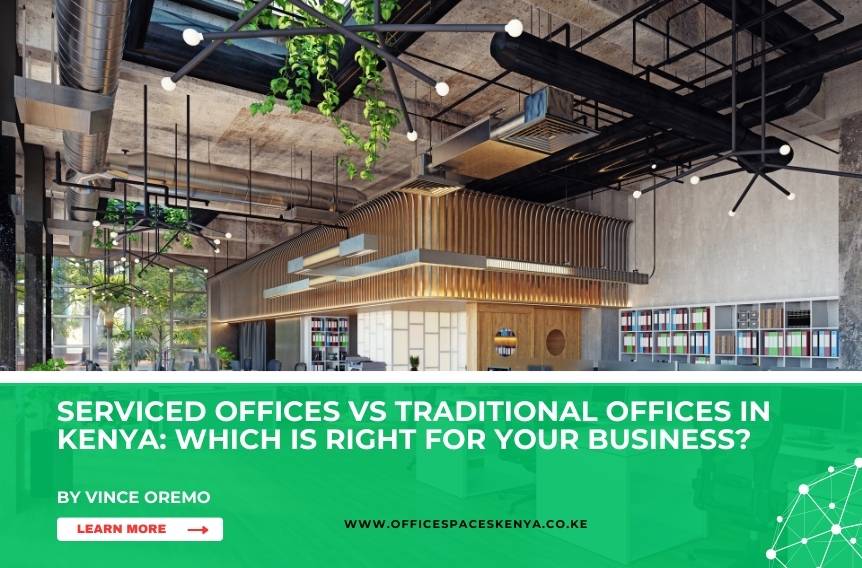
Serviced Offices vs Traditional Offices in Kenya: Which Is Right for Your Business?
Finding the right office space is one of the biggest decisions for any business in Kenya. Whether you’re a startup in Nairobi, a growing SME in Mombasa, or a remote team expanding into Kenya, the type of office you choose has a huge impact on your budget, productivity, and company culture.
- 1. What Are Serviced Offices?
- 2. What Are Traditional Offices?
- 3. Cost Comparison: Serviced vs Traditional Offices in Kenya
- 4. Flexibility & Lease Terms
- 5. Amenities & Services: What You Actually Get
- 6. Who Should Choose Serviced Offices?
- 7. Who Should Choose Traditional Offices?
- 8. Pros & Cons Summary
- 9. Final Verdict: Which Is Right for YOUR Business?
- 10. Conclusion
Today, two main office models dominate the Kenyan market:
- Serviced Offices
- Traditional Offices
Both options have their strengths — the real question is: Which one is right for your business?
This guide breaks everything down in a simple, friendly way so you can confidently choose the office that supports your growth and fits your budget.
1. What Are Serviced Offices?
Serviced offices are fully equipped, ready-to-use workspaces offered by workspace providers. When you move in, you literally plug in your laptop and start working — no setup, no renovations, no stress.
What’s Typically Included?
A quality serviced office in Kenya comes with:
- Fully furnished workstations
- High-speed internet
- Meeting rooms
- Printing & scanning facilities
- Reception services
- Cleaning & maintenance
- Security & CCTV
- Backup power
- Kitchen/lounge areas
- Flexible lease terms (monthly, quarterly, or yearly)
Where are serviced offices located in Kenya?
They are mostly in high-demand business areas like:
- Westlands
- Kilimani
- Karen
- Upper Hill
- Nairobi CBD
- Gigiri/Runda
Popular providers include Nairobi Garage, Ikigai, Kofisi, Regus, and various boutique coworking spaces.
Who uses serviced offices?
These spaces are popular with:
- Startups
- SMEs
- Freelancers
- Consultants
- Remote or hybrid teams
- International companies setting up quickly in Kenya
They offer a modern, friendly, and flexible approach to work.
2. What Are Traditional Offices?
A traditional office is a conventional commercial space that a business leases directly from a landlord. It’s usually an empty shell, meaning you handle everything from interior design to utilities.
What businesses handle in a traditional office:
- Renovations & fit-out
- Furniture
- Internet installation
- Wiring & cabling
- Cleaning staff
- Receptionist (optional)
- Security arrangements
- Utility bills
- Service charge
- Insurance
Traditional offices are ideal for organizations that want full control and are ready for long-term commitments.
Where are traditional offices common?
Almost every commercial district in Kenya has traditional office buildings, especially:
- Westlands
- Upper Hill
- Kilimani
- Riverside Drive
- Karen Office Park
- Nairobi CBD (older buildings)
3. Cost Comparison: Serviced vs Traditional Offices in Kenya
Let’s look at the major cost differences — because this is where many businesses make their decision.
Serviced Offices (Pay-As-You-Go Model)
Serviced offices charge per desk, per month or per workspace (e.g., private office for 4 people).
What you’re paying for:
- Space
- Furniture
- Internet
- Cleaning
- Meeting room access
- Security
- Utilities
- Maintenance
No hidden costs. No upfront spending.
Traditional Offices (Lease + Setup Costs)
A traditional office is priced per square foot per month.
However, the real costs include:
- Rent deposit (3 months or more)
- Service charge
- Fit-out cost (very expensive)
- Furniture
- Internet setup
- Generators/inverters
- Long-term lease commitments
Traditional offices often require high upfront investment, especially for new businesses.
Sample Cost Comparison (Simplified)
| Cost Item | Serviced Office | Traditional Office |
|---|---|---|
| Furniture | Included | You buy |
| Internet | Included | You install and pay monthly |
| Meeting Rooms | Included | You pay to build and furnish |
| Deposit | 1 month (average) | 3–6 months |
| Utilities | Included | Separate (depends on usage) |
| Cleaning | Included | You hire a cleaner |
| Security | Included | Paid separately |
| Setup Time | 0 days | 30–120 days |
Serviced offices win on convenience and cost-efficiency, especially for smaller teams.
4. Flexibility & Lease Terms
Serviced Offices
- Month-to-month, 3-month, or 1-year contracts
- No penalties for scaling up or down
- Ideal for teams that may grow or shrink quickly
- Perfect for project-based work
Traditional Offices
- 1 to 6-year leases
- Early termination penalties
- Hard to resize or relocate
- Better for long-term, stable operations
If flexibility matters to you, serviced offices offer unbeatable freedom.
5. Amenities & Services: What You Actually Get
Serviced Offices Include:
- Ready meeting rooms
- Coffee/tea areas
- Telephone booths
- Lounge spaces
- Receptionists
- IT support
- Backup power & water
- Networking events
- Community feel
Traditional Offices Require You to Handle:
- All furniture & décor
- Boardroom setup
- Signage
- Hiring cleaning staff
- Hiring receptionists
- Setting up backups
- Dealing with repairs
- Paying utilities directly
If you want zero hassle, a serviced office is the simple winner.
6. Who Should Choose Serviced Offices?
Serviced offices are the perfect match for:
✔ Startups
Because costs are predictable and low.
✔ SMEs
Ideal for businesses that want quality without massive overheads.
✔ Freelancers & Consultants
Pay only for the space you need.
✔ Remote Teams
Perfect for hybrid work or occasional meet-ups.
✔ International Companies
Move in fast, without dealing with Kenyan bureaucracy.
✔ Businesses without large budgets for setup
No furniture or renovation costs.
If flexibility, speed, and ease matter to you, choose serviced offices.
7. Who Should Choose Traditional Offices?
Traditional offices work better for:
✔ Large companies needing 50+ employees
More space, long-term plans, and internal control.
✔ Organizations needing customized spaces
Branding, layout, private floors, controlled access.
✔ Businesses that prefer long-term stability
Banks, law firms, NGOs, government-affiliated projects.
✔ Teams requiring 100% privacy
Especially those handling sensitive data.
✔ Companies with enough budget for setup and long leases
If your business is stable, large, and needs full control, traditional offices are a good fit.
8. Pros & Cons Summary
Here’s a quick side-by-side look:
| Serviced Offices | Traditional Offices |
|---|---|
| Flexible | Long-term stability |
| Zero setup | High setup cost |
| All-inclusive | Many separate bills |
| Move-in ready | Takes weeks/months to set up |
| Community & networking | Limited interaction |
| Great for small/medium teams | Best for large teams |
| Predictable monthly cost | Costs vary month to month |
| Less privacy | Full privacy |
Both have their place — it depends on your business model.
9. Final Verdict: Which Is Right for YOUR Business?
Here’s a simple way to decide:
Choose a Serviced Office if you need:
- Flexibility
- Low upfront costs
- Modern space
- Fast setup
- Amenities included
- Small to medium team support
Choose a Traditional Office if you need:
- Long-term control
- Custom design and branding
- Large private space
- Corporate-style privacy
- A long-term office plan
Both serviced and traditional offices work beautifully in Kenya — you just need the one that fits your budget, size, and future plans.
10. Conclusion
The Kenyan office space market is evolving fast, and businesses now have more choice than ever. Whether you’re moving into a sleek serviced office in Westlands or securing a full traditional office in Upper Hill, the space you choose should support your goals — not strain your budget.
The best office is the one that helps your team thrive, grow, and work comfortably every day.